
If you are a Canadian who recently won money in the United States, seeing a 30% casino tax withholding at the cashier is jarring.
Your first instinct is usually the same:
Why did the casino take tax? I don't even pay gambling tax in Canada.
The confusion makes sense. The answer lies in a fundamental difference between how Canada and the United States treat gambling income.
At Casino Tax Refund, we work exclusively with Canadians navigating exactly this situation. What looks like a mistake at the cashier is actually the result of two very different tax systems colliding at the same window.
Here is what is actually happening.
Why Canada Does Not Tax Gambling Winnings
In Canada, casual gambling winnings are generally not considered taxable income.
The Canada Revenue Agency (CRA) views gambling as a form of windfall, unless the individual is operating as a professional gambler carrying on a business. For the average casino visitor, lottery winner, or poker player, winnings are typically tax-free.
There is also no automatic withholding at Canadian casinos. When you win, you are paid in full.
That framework shapes Canadian expectations.
So when you travel to the United States and experience a completely different system, the gap becomes immediately visible.
Why the U.S. Taxes Casino Winnings for Canadians
The United States approaches gambling through a different lens.
Under U.S. federal tax law, gambling winnings are considered taxable income. This applies not only to American residents but also to foreign visitors earning income within U.S. borders.
The IRS operates under a principle that income generated in the United States is subject to U.S. tax rules. That includes casino winnings.
For non-residents, the system relies on withholding at source. When certain types of gambling winnings exceed reporting thresholds, the casino must withhold 30% and remit it to the federal government.
This is not a discretionary casino policy. It is a statutory requirement.
Why Canadians Face a 30% Withholding Rate in Vegas
When you win in the United States, the IRS classifies you as a non-resident alien. That is simply a technical tax term for someone who is not a U.S. resident.
For many types of U.S.-source income paid to non-residents, the default withholding rate is 30%.
Gambling winnings fall within that category.
ℹ️ The IRS applies a flat 30% withholding rate to gambling winnings paid to non-residents. It does not calculate your net gambling results for the year at the cashier window. The withholding is collected upfront, at the moment of payout.
From the U.S. government's perspective, this ensures compliance.
From a Canadian visitor's perspective, it feels arbitrary.
When Does the 30% Casino Withholding Apply to Canadians?
Not every casino win triggers withholding.
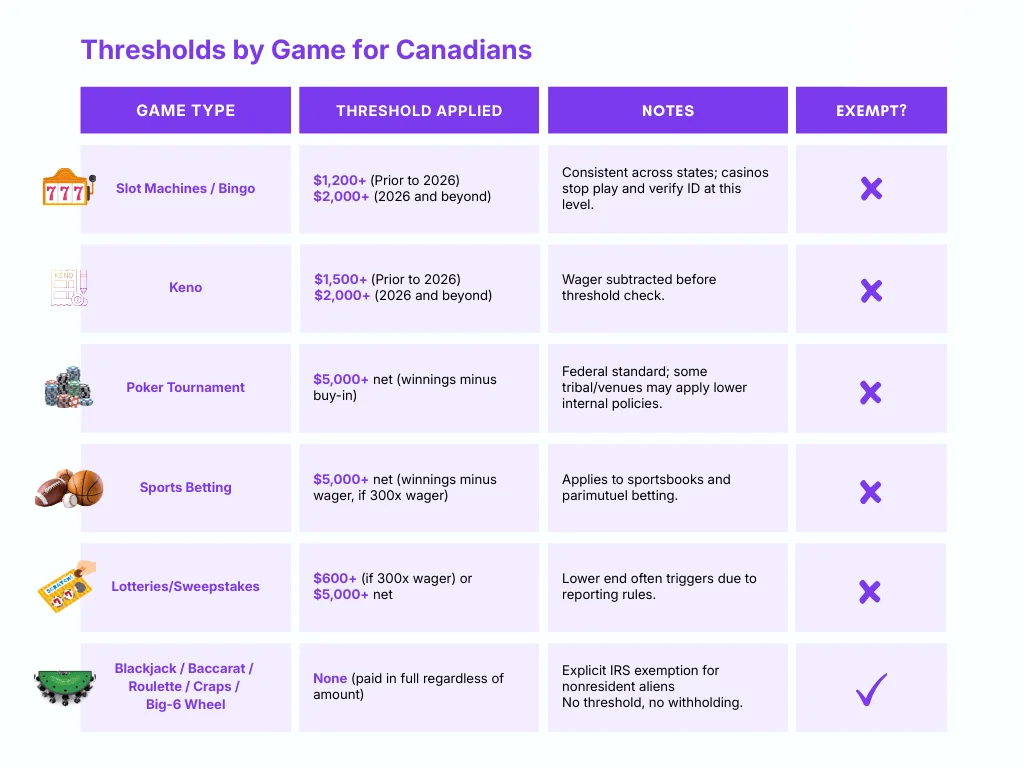
Under U.S. federal reporting rules, withholding is generally applied only when certain payout thresholds are reached. Below those thresholds, winnings are usually paid in full without federal paperwork.
Once a payout crosses a reporting threshold, the casino must:
ℹ️ Once the payout threshold is crossed, the casino has no discretion. The withholding is automatic and immediate, regardless of your nationality, your losses that day, or how long you have been playing.
Why Your Losses Do Not Reduce the Withholding at the Casino
This surprises a lot of Canadians. You may have lost $2,000 earlier that same day, so why is the casino taxing a separate win as if it happened in isolation?
The answer lies in how the U.S. system is structured.
Withholding is designed as a prepayment mechanism. The IRS collects tax at the moment certain income is paid. It does not attempt to evaluate your total gambling activity for the year at the cashier window.
Whether losses can offset winnings is handled separately through formal tax filing procedures. It is not part of the payout process.
This is why the withholding may not reflect your overall annual results.
The contrast becomes visible the moment you move between the two systems. Canada treats gambling as a windfall; the United States treats it as income. That single philosophical difference is why 30% disappeared before you left the building.
Is the 30% Withholding the Final Amount for Canadians?
Not necessarily.
The 30% is a withholding, not automatically your final tax liability. Under certain circumstances, Canadian residents may be able to reassess that withholding through formal filing under the Canada-U.S. tax treaty.
ℹ️ The Canada-U.S. tax treaty creates a legal pathway to recover some or all of the 30% withholding. This involves a formal IRS filing with specific forms, documentation, and timelines. Getting it wrong can result in a rejected claim or missed deadlines.
We explain how that process works in detail in our step-by-step guide to recovering your casino withholding. This article focuses specifically on explaining why the deduction occurs in the first place.
What Happens Next?
Now that you understand why the casino withheld 30%, the natural next question is whether you can get it back. For most Canadians, the answer is yes. Casino Tax Refund exists specifically to guide Canadians through that recovery process. If you want to know whether your situation qualifies, that is the right place to start.
The deduction is not a mistake, a casino policy, or a penalty. It is a mechanical outcome of the Canada-U.S. tax gap. And because it is a withholding rather than a final tax, many Canadians are entitled to recover it.